

Pre-arrival registration collects information before a stay. Actual arrival is the event of the guest reaching the accommodation. A hotel should keep those states distinct because a submitted form does not prove the guest has arrived, the room is ready, the details are correct or an official report has been filed.
This guide is for owners and reception teams designing the handover between online intake and the welcome at the property. For the earlier planning steps, use CheckInd's existing pre-arrival checklist. Here, the focus is what remains when a form has already been completed.
Give each status a precise meaning
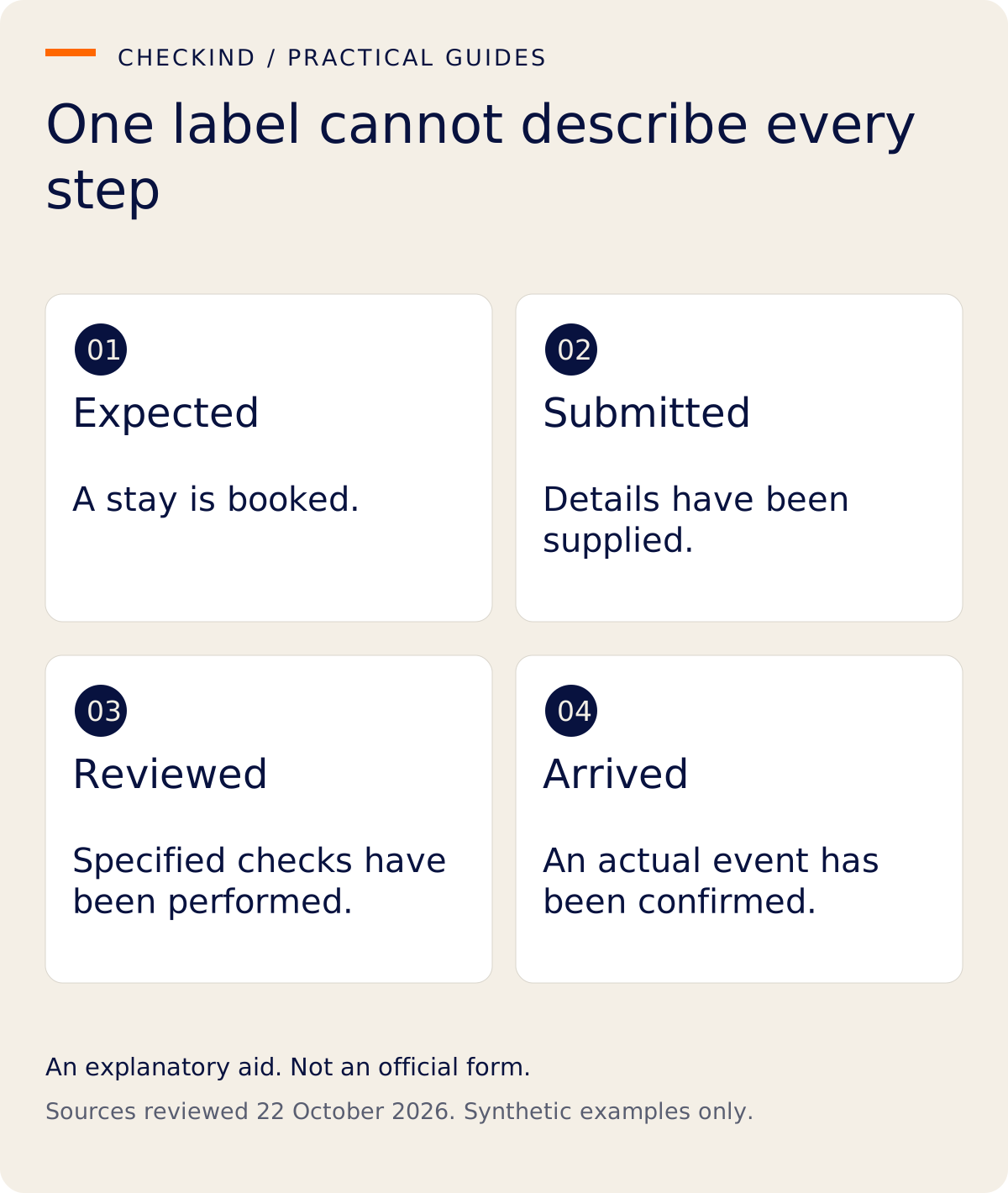
“Expected” can mean a reservation exists. “Details submitted” can mean the guest completed a form. “Reviewed” should describe the particular checks performed, rather than a broad claim of identity verification. “Arrived” should reflect a confirmed actual event.
A useful status label answers one question. If one “complete” badge is used for intake, document review, arrival and official reporting, a second staff member cannot tell what still needs attention. Clear labels matter even when the property uses a simple worksheet.
| State | What it can establish | What it does not establish |
|---|---|---|
| Booking recorded | Expected stay context | Actual arrival |
| Registration submitted | Information has been supplied | Accuracy or document authenticity |
| Details reviewed | Specified checks were performed | Every legal or reporting duty completed |
| Actual arrival confirmed | The event has been recorded | Official submission or acceptance |
Review changes with the guest
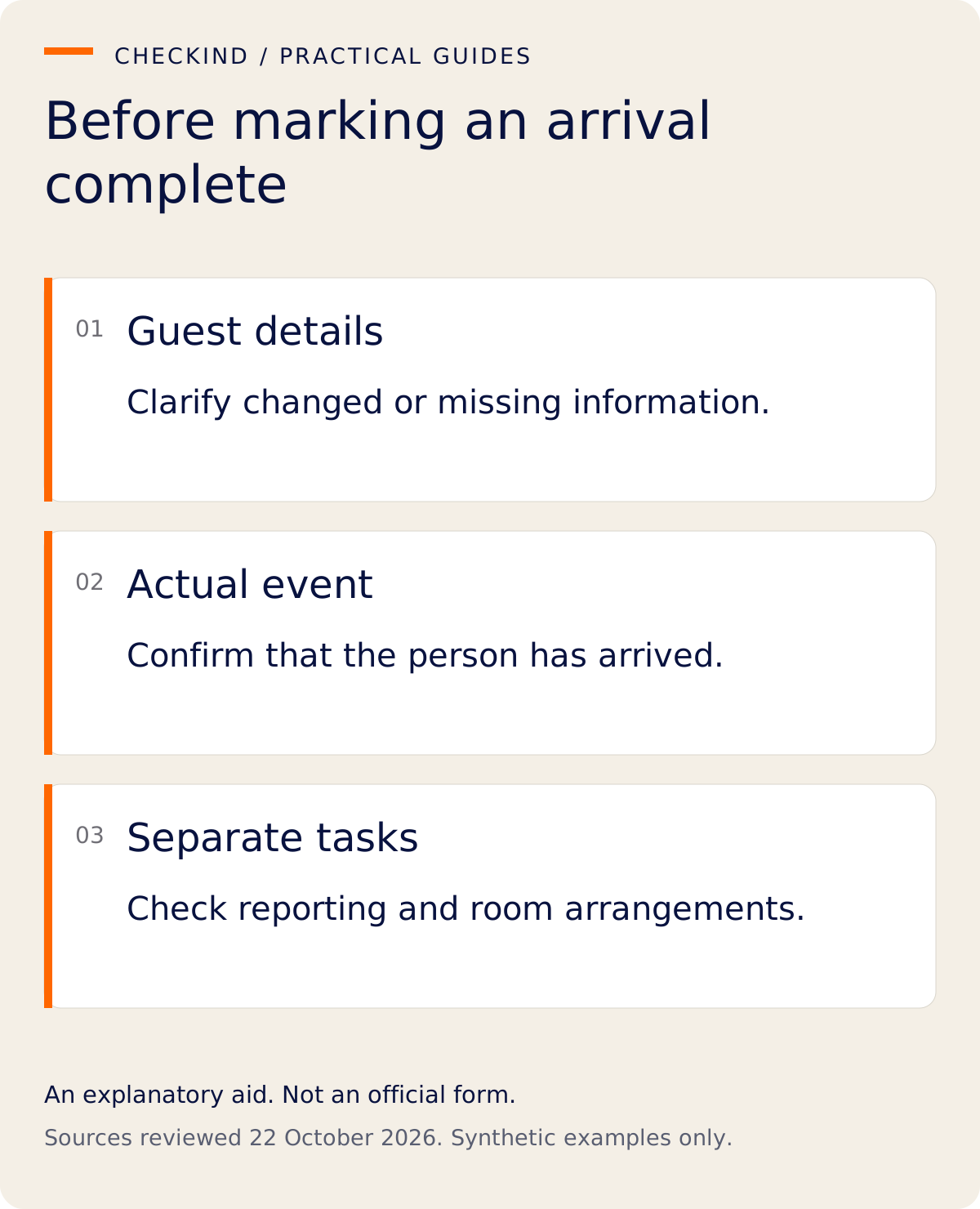
A pre-arrival form may be accurate when submitted and still need a correction later. The travel plan may change, an accompanying person may be different or the guest may notice a transcription mistake. Give reception a way to ask about those changes without making the guest start again unnecessarily.
Explain which information needs review and why. Do not silently edit a guest's statement to match a reservation if the two describe different things. Keep booking changes and corrections to guest particulars distinguishable in the property's authorized records.
Keep room readiness and access separate
A guest can complete registration before the room is ready. Another guest can arrive early and need staff assistance before submitting details. Neither situation should be described as a software failure solely because the reservation, registration and room processes have different states.
Agree who handles the welcome, missing information and access instructions. For an independent host, that may be a single person with a clear sequence. Registration should not be advertised as a door-access product unless that actual capability exists.
Foreign guest reporting needs its own checkpoints
For covered accommodation, Rule 17 concerns particulars and arrival signing, along with departure particulars. Its reporting limits are tied to actual arrival and departure. A guest's online submission the day before arrival does not establish those events.
Keep the arrival process, actual event and official reporting task clear to the designated operator. Do not assume an earlier registration signature establishes the required arrival attestation. Confirm the property's process against the rule and current official directions.
A fictional Friday arrival
Illustrative Tamarind Villa receives a completed registration on Thursday. The booking shows Friday afternoon, but the guest arrives later that evening. The host confirms the actual arrival and reviews a changed onward plan with the guest.
A clear record can retain the planned booking information, the guest's supplied particulars and the confirmed event without pretending they are the same fact. The host then handles any applicable official reporting separately. The example illustrates a process; it does not describe an automatic CheckInd event or notification.
A short handover before the welcome
Ask the person covering arrival to confirm:
- They can identify the correct property and stay.
- They know whether the form is submitted, reviewed or still incomplete.
- They can find the unresolved question without opening unrelated guest documents.
- They know who confirms actual arrival and handles required attestation.
- They know who completes any separate reporting task.
- They can help a guest who cannot use the online route.
Write the next action in plain language. “Ask guest to confirm previous stay” is more useful than “pending verification” when the latter hides what remains unclear.
CheckInd's role
CheckInd supports digital guest registration, document capture and organized records for property review. Expanded staff-confirmed actual-event and Form III preparation features are in development. Do not treat an illustrative workflow as evidence that those features are available in production.
The digital check-in guide explains the registration journey. Use the Form III page for the separate reporting-product boundary.
Questions owners ask
Can we collect information before the guest arrives?
A pre-arrival process can help prepare relevant information, subject to applicable requirements and any booking-platform rules. It does not remove the remaining arrival steps.
Does a completed form guarantee a quicker check-in?
No measured time saving is claimed. The result depends on the information, the guest's needs and the property's process.
Should every guest use the same online route?
Plan appropriate assistance and check applicable requirements. A useful digital process should make it clear where help is available.
At the next handover, replace one vague “complete” label with the specific task it describes. That small change can make the remaining work easier to see.
Operational suggestions and synthetic examples. They do not establish government approval, feature availability or legal compliance.
- Immigration and Foreigners Rules, 2025; G.S.R. 596(E), 1 September 2025 — Rule 17(1), (5), (6), Form III schedule
- Immigration and Foreigners (Amendment) Rules, 2026; G.S.R. 424(E), 1 June 2026 — Amendments to Rules 12, 18 and 21; no amendment to Rule 17 in this instrument
- Official Form III public portal — Public notice includes OCI; no authenticated procedure tested
- CheckInd current Form III product boundary — Digital registration is available; expanded Form III preparation remains in development.