

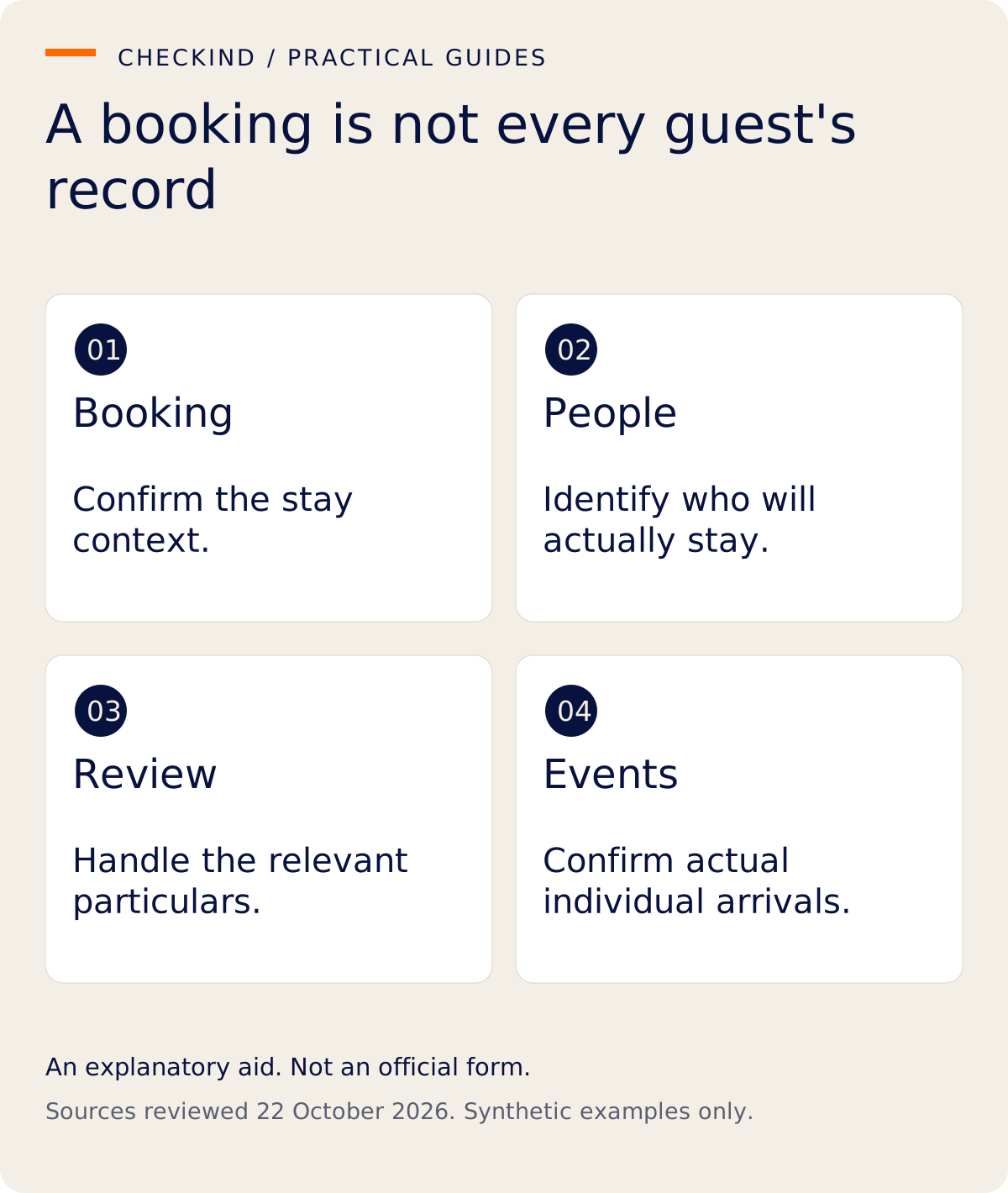
A group booking identifies a reservation, but it does not automatically provide complete registration information for everyone staying. A useful reception process separates the booker, the people actually arriving and the correct property or stay context for each record.
This guide is for Indian small hotels, guesthouses and independent hosts handling family or group arrivals. The suggested matrix is an operational aid. It does not prescribe a universal document list, determine requirements for minors or establish a bulk government-filing procedure.
Start with the difference between booker and guest
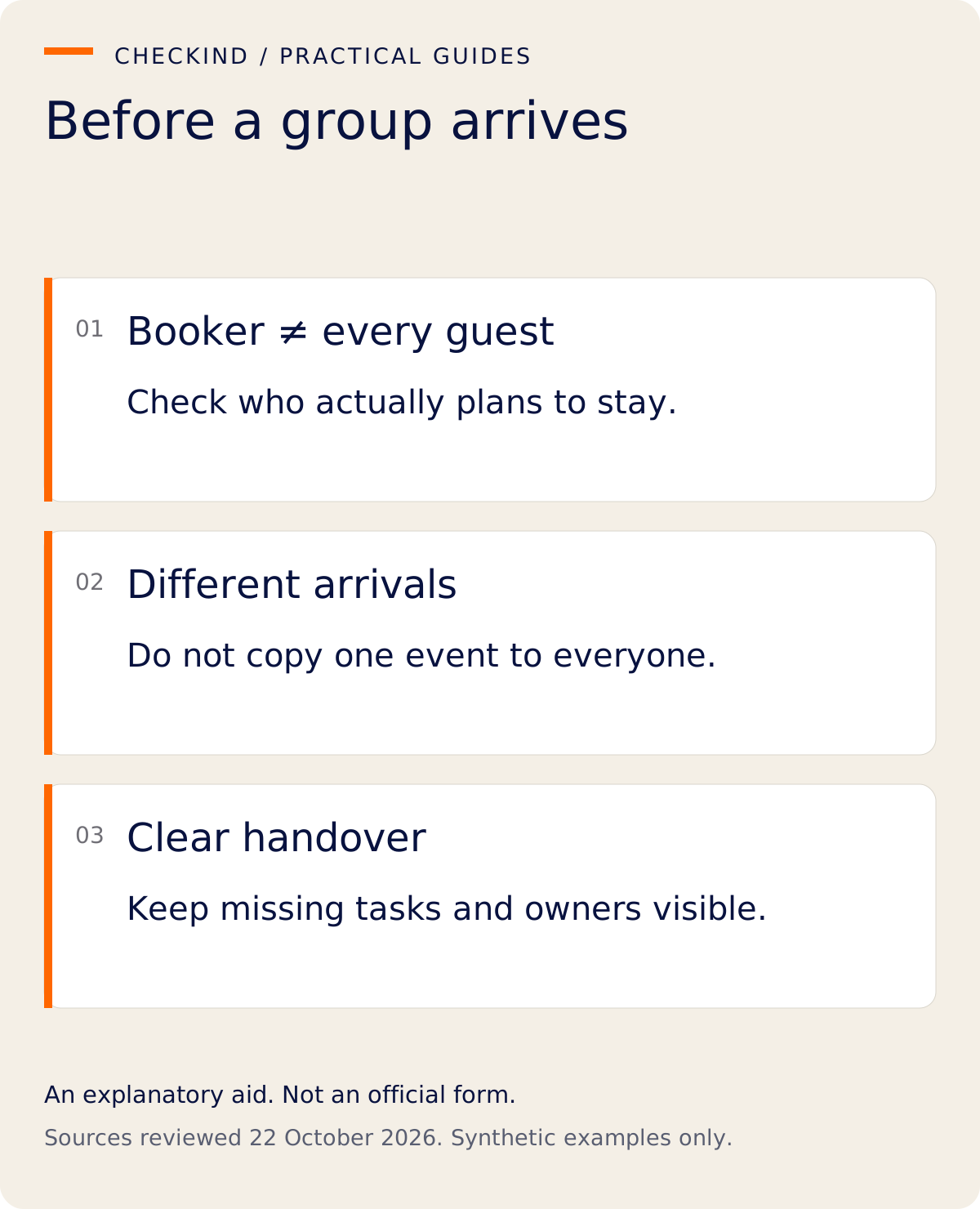
One person may reserve rooms for several relatives or colleagues. They may arrive separately, change their plans or not stay at all. Avoid copying the booker's name into every guest record merely because it is the first available detail.
Check who is expected and who has actually arrived. If the property uses a registration link, verify which booking or stay it belongs to before sharing it. Do not assume that one completed form covers every person mentioned in a message.
Prepare a small group matrix
Use references and limited operational fields rather than an open sheet of identity numbers:
| Illustrative reference | Booking context | Current state | Next action |
|---|---|---|---|
| G-01 | Family booking A | Details supplied | Assigned reviewer to clarify one answer |
| G-02 | Family booking A | Expected later | Confirm actual arrival when it occurs |
| G-03 | Group booking B | Needs assistance | Reception to help through the applicable process |
These are fictional references, not customer records. The matrix describes work; it does not establish that a guest or document has been verified.
Keep the room discussion separate from identity review
Room allocation can change while the underlying guest remains the same person. A guest may also arrive before a room is ready. Record those operational changes without changing a person's identity particulars to match an old room list.
Agree who handles room readiness and who reviews registration. At a small property, one person may cover both tasks. The benefit is a clear distinction, not an assumption that more staff or a complex system is necessary.
Review the relevant particulars for each person
Determine which information is applicable, permitted and required for the particular guest and property. Do not infer nationality, age or authorization from a family relationship. Do not use a booking platform's verified-booker badge as evidence that the property has received every necessary stay particular.
Foreign guest accommodation requires attention to the current Rule 17 framework. OCI is expressly included. For minors, unusual authorization situations or uncertain representation, confirm the relevant official requirements rather than improvising from this operations template.
Let people arrive at different times
A group may reach the property in separate vehicles or after different travel connections. An organizer's arrival should not automatically be treated as everyone's actual arrival.
Give the covering reviewer a way to identify the people still expected and the actual events already confirmed. Avoid using the scheduled group time to make an incomplete arrival list appear finished. Handle applicable reporting through the designated process for the relevant circumstances.
A fictional mixed arrival
Illustrative River Courtyard expects two rooms under one booking. The booker arrives first, another adult follows in the evening and a third expected person changes plans. Reception reviews the relevant particulars for the people who actually stay and keeps the changed booking context clear.
The reviewer does not create a guest record with invented details for the person who never arrived. Nor does the first completed form become a blanket statement that every other person's details were checked. The example is about record discipline, not an automatic CheckInd group feature.
Questions to settle before a busy arrival
- Which person is the booking contact, and who will actually stay?
- How will separate arrivals be recorded?
- Which reviewer helps a guest who cannot complete an online form?
- Where will missing information be recorded without exposing documents?
- Who handles changes in rooms or guest count?
- Who completes any separate official reporting?
- How does the next shift know what remains unresolved?
Keep the answers short enough for someone covering reception to use. A matrix that requires repeated copying of sensitive data may create more confusion than it resolves.
What to ask a software provider
Use a fictional group during a walkthrough. Ask how the product represents multiple guests, changed plans, staff assistance and review. Mark any desired feature as unverified until it is demonstrated in the relevant released version.
CheckInd supports digital guest registration and organized property records. This article does not assert a released group dashboard, automatic room synchronization or bulk Form III submission. The existing registration guide provides the broader product context.
Questions owners ask
Does the booker's platform verification cover everyone?
Do not assume that it supplies the property's required particulars or completes separate reporting.
Should the organizer send everyone's documents in one chat?
First establish an appropriate, permitted route and the information actually needed. Convenience alone does not settle access or data-handling questions.
Is one arrival time enough for the whole group?
Record actual events according to the applicable process. Different arrivals should not be silently replaced with a group estimate.
Before a group arrives, rehearse the matrix with three fictional references. Check whether the next shift can identify who is expected, what is reviewed and what remains open.
Operational suggestions and synthetic examples. They do not establish government approval, feature availability or legal compliance.
- Immigration and Foreigners Rules, 2025; G.S.R. 596(E), 1 September 2025 — Rule 17(1), (5), (6), Form III schedule
- Immigration and Foreigners (Amendment) Rules, 2026; G.S.R. 424(E), 1 June 2026 — Amendments to Rules 12, 18 and 21; no amendment to Rule 17 in this instrument
- Official Form III public portal — Public notice includes OCI; no authenticated procedure tested
- CheckInd current Form III product boundary — Digital registration is available; expanded Form III preparation remains in development.