

Form III is the accommodation-reporting form prescribed by the Immigration and Foreigners Rules, 2025; the schedule identifies it as the earlier Form C. For a hotel or homestay owner, the useful distinction is between collecting a guest's registration details and completing the property's official reporting duties. A completed guest record is not evidence of a government filing.
This guide is for Indian accommodation operators preparing to welcome foreign guests. It explains the national framework and a practical way to organize staff responsibilities. Property-specific directions, exceptions and authenticated portal procedures still need confirmation with the relevant authority.
Start with the current form and official source
The 2025 Rules, notified as G.S.R. 596(E) on 1 September 2025, contain Rule 17 and the Form III schedule. Use “Form III (formerly Form C)” on first reference so staff recognize both names. The official portal continues to mention both.
Do not select a process solely because an older blog, downloaded checklist or booking-platform help page calls it Form C. Check the governing text and current official instructions. The 1 June 2026 amendment changes Rules 12, 18 and 21; it does not amend Rule 17.
Separate the guest's task from the property's task
Rule 17(1) expressly includes OCI cardholders. It requires the keeper to obtain the necessary particulars and an arrival signature, and to record departure date, time and onward address. The keeper must maintain the specified particulars electronically for at least one year. That record requirement does not, by itself, settle how every raw document image should be retained.
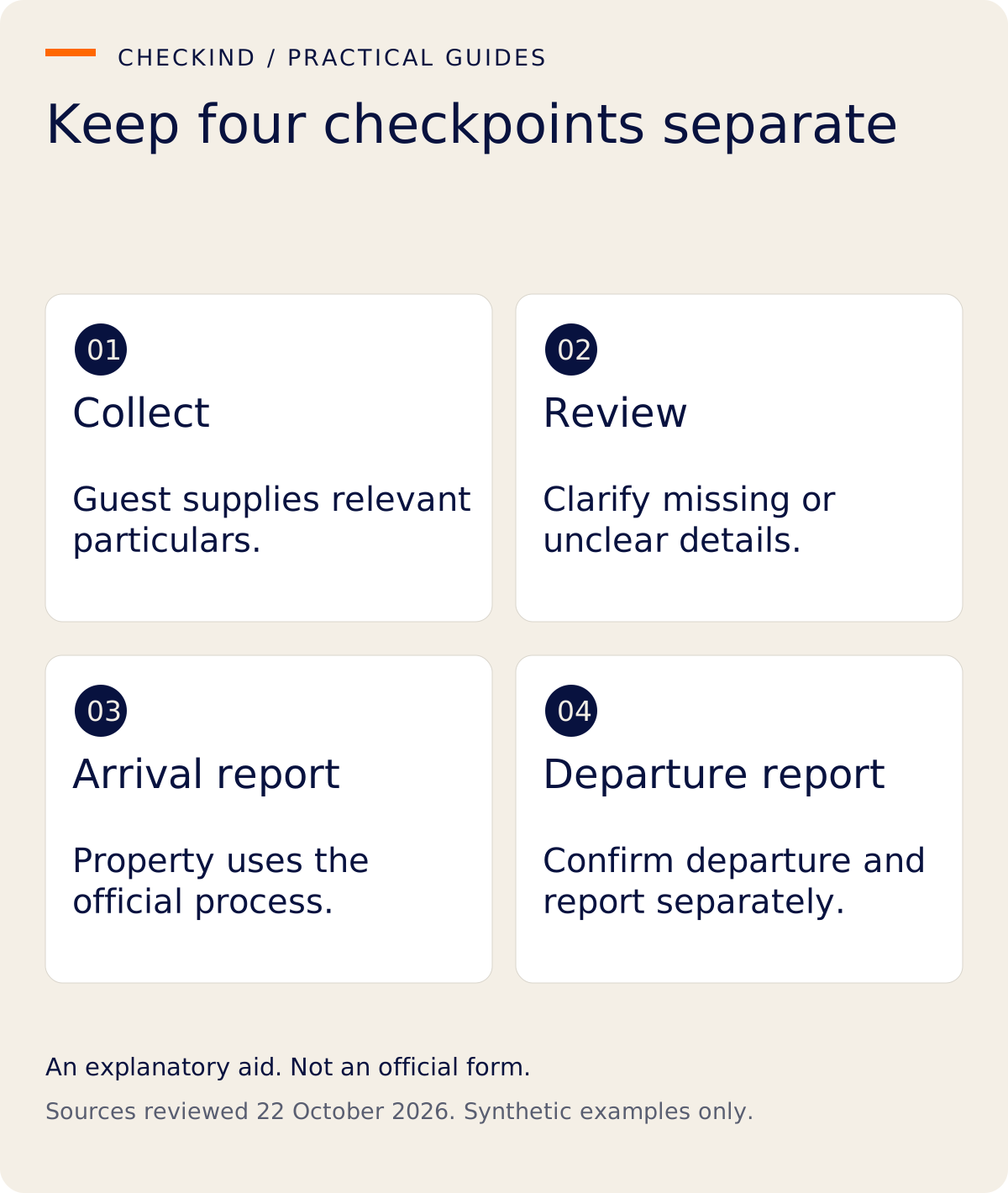
A suggested reception process has four checkpoints: collect the information, review unclear details with the guest, handle the official arrival report, and handle the departure particulars and report. Give each checkpoint an owner. The owner may be the same person at a small homestay, but the tasks remain separate.
Give arrival and departure their own checkpoints
Rule 17(5) requires arrival particulars to be transmitted through the designated official process as soon as possible, no later than 24 hours after arrival. Rule 17(6) sets a separate limit of 24 hours after departure for departure details. Staff should work promptly rather than treat the outer limit as a recommended waiting period.
A reservation's planned dates are not proof of actual events. If an expected afternoon arrival becomes a late-night arrival, record what actually happened. A filled pre-arrival form does not establish arrival, official submission or acceptance. See the companion deadline article when published; until then, use the source provisions directly.
Prepare a clear property workflow
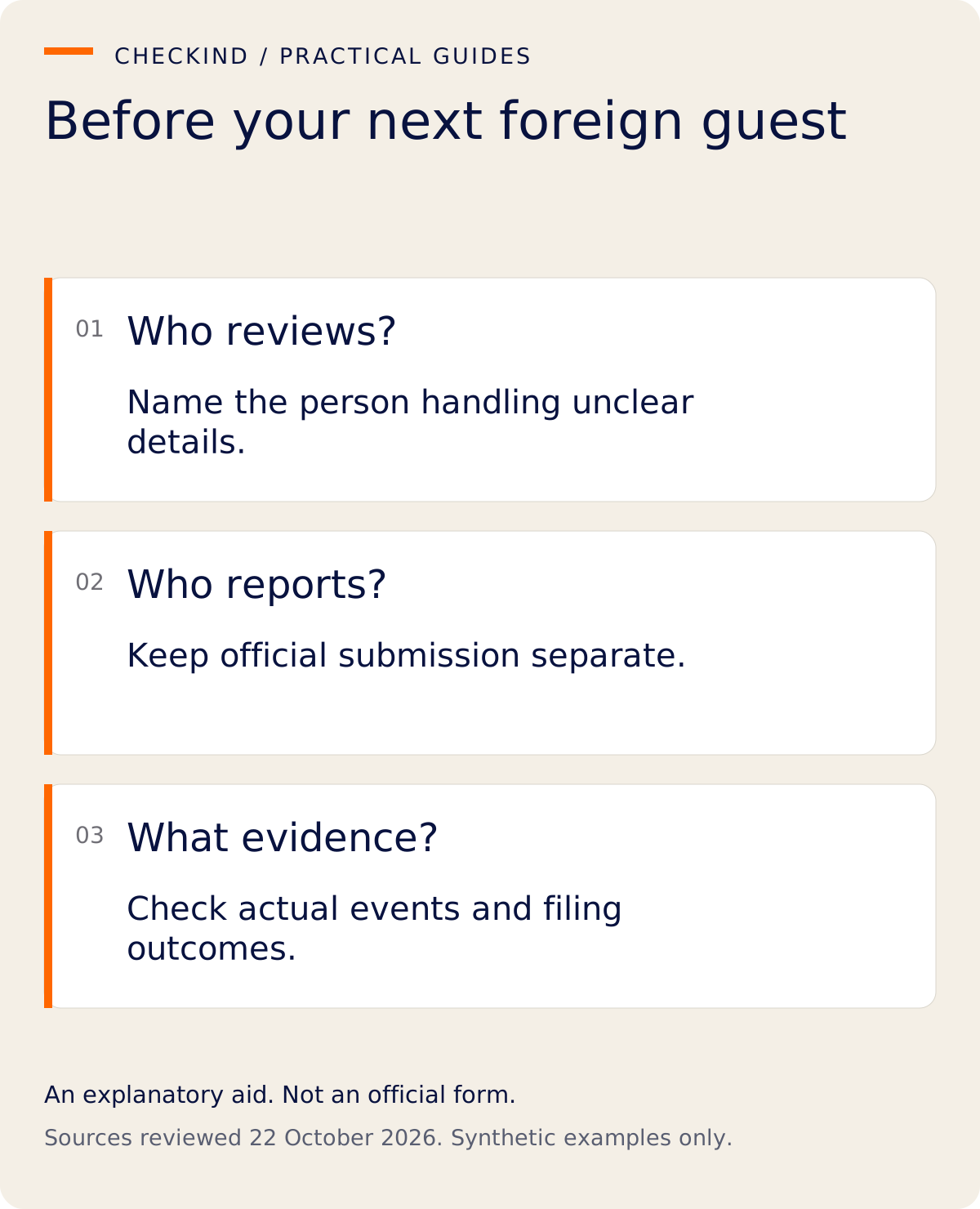
Before the next international arrival, ask your team to answer these questions:
- Is the property ready to use the current designated reporting process?
- Who collects and reviews the guest's details?
- Who handles missing information or an unclear authorization document?
- Who submits official reports and checks the resulting evidence?
- Who records actual departure and the guest's next destination?
- Who covers these tasks when the usual reviewer is absent?
These are operating suggestions, not additional legal requirements. Keep staff notes proportionate. A shared handover should identify an unresolved task without broadcasting full passport numbers or document copies to everyone.
A fictional example: one stay, several responsibilities
At illustrative Tamarind House, a foreign guest sends registration details before travelling. The host reviews them but keeps the stay marked as expected. On arrival, the host confirms the event and completes the applicable arrival steps. Official reporting happens through the designated government process.
At checkout, the host confirms the departure particulars and handles the separate departure report. The saved registration, actual events and official filing evidence each answer a different question. None should be used as a substitute for the others.
Where CheckInd fits today
CheckInd's production-evidenced capabilities include digital foreign guest registration, document capture and organized records for review. Expanded Form III preparation, including its OCI-specific workflow, remains in development. CheckInd does not submit reports to the government or independently verify government acceptance. Review the current product boundaries before choosing a workflow.
OCR availability is not verified for current production marketing. Document capture should not be described as proof of authenticity, and illustrations should not be mistaken for working government integration.
Questions owners ask
Is Form C a different form that hotels should keep filing separately?
Form III is the current prescribed name, with Form C identified as the earlier name. Follow current official instructions rather than creating duplicate reports because both terms appear online.
Does an OCI card remove accommodation reporting?
Rule 17(1) expressly includes OCI cardholders. Do not assume a visa or personal-registration exemption answers a different accommodation-reporting question.
Does this guide cover every local or special case?
No. It summarizes the cited framework. Ask the relevant authority about special circumstances, disputed fields or procedural questions before acting.
For your next team handover, assign one person to each checkpoint and identify the official source they will use. That is a practical starting point for a process your staff can explain and review.
General information for covered Indian accommodation. Not a complete property-specific compliance checklist; confirm uncertain procedures with the relevant authority.
- Immigration and Foreigners Rules, 2025; G.S.R. 596(E), 1 September 2025 — Rule 17(1), (5), (6), Form III schedule
- Immigration and Foreigners (Amendment) Rules, 2026; G.S.R. 424(E), 1 June 2026 — Amendments to Rules 12, 18 and 21; no amendment to Rule 17 in this instrument
- Official Form III public portal — Public notice includes OCI; no authenticated procedure tested
- CheckInd current Form III product boundary — Digital registration is available; expanded Form III preparation remains in development.