

Arrival and departure have separate reporting limits under Rule 17 of the Immigration and Foreigners Rules, 2025. Rule 17(5) requires arrival information as soon as possible and no later than 24 hours after arrival. Rule 17(6) requires departure details as soon as possible and no later than 24 hours after departure.
For a reception team, the practical lesson is to record the real event, identify the responsible operator and check completion. A planned check-in time, a booking confirmation or a guest's completed online form does not establish that the guest has arrived.
Read the two provisions together
The official Gazette contains both limits. The 24-hour period is an outer limit, not an instruction to delay reporting until the next day. Use the designated official process and follow any relevant operational directions.
This article uses Indian Standard Time for all examples. Dates and times below are fictional calculations illustrating the cited limits, not records of a real guest or advice that a missed deadline is acceptable.
Example 1: an afternoon arrival
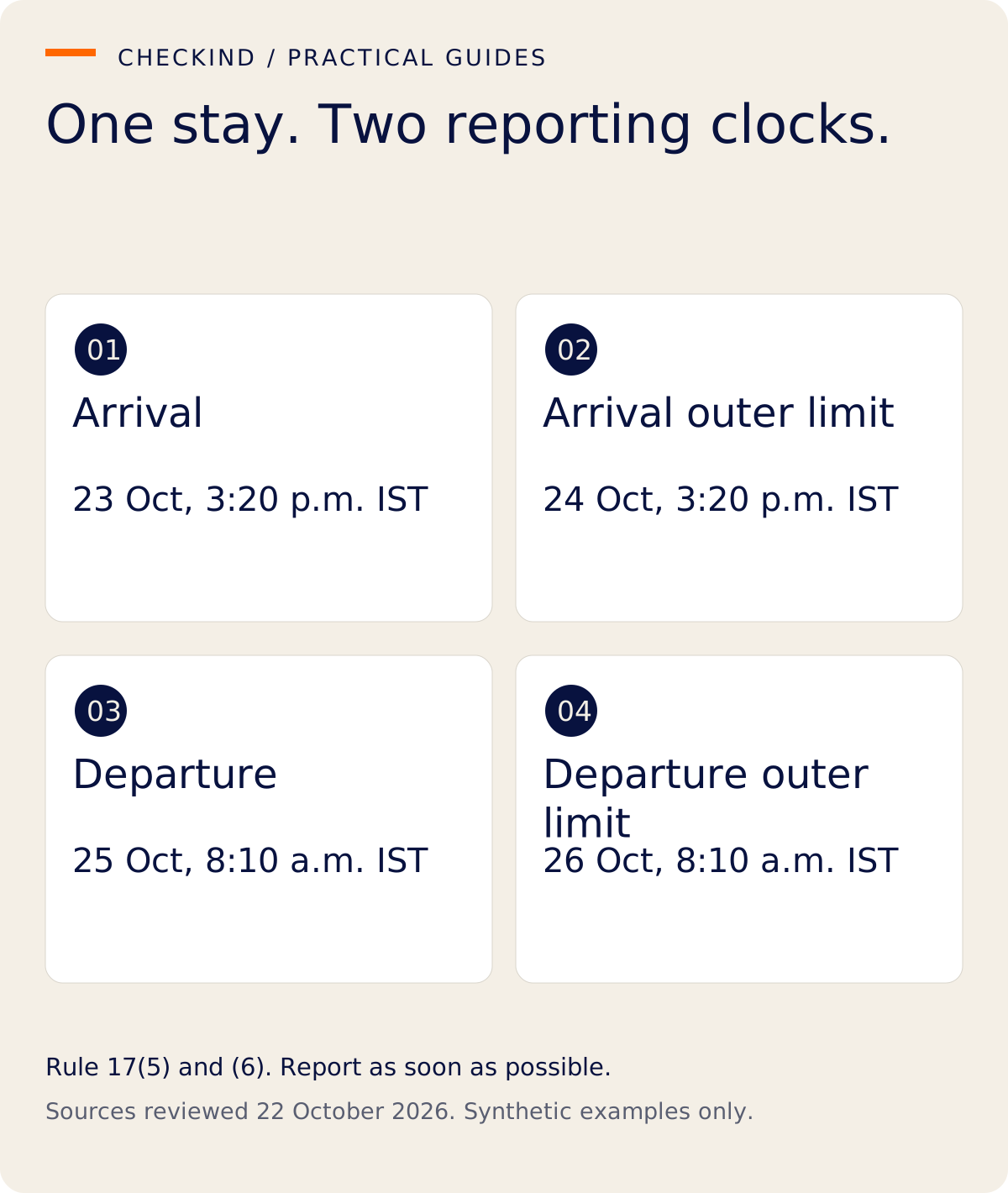
Suppose a guest actually arrives on 23 October at 3:20 p.m. IST. Twenty-four hours later is 24 October at 3:20 p.m. IST. The team should arrange prompt arrival reporting, with that time as the illustrated outer limit.
If the reservation had shown an expected arrival at noon, the reservation time would not prove the actual event. If the guest completed a digital form the previous evening, that completion would not start a different reporting clock. Keep the actual-arrival record and reporting outcome separate.
Example 2: departure creates a second task
The same fictional guest leaves on 25 October at 8:10 a.m. IST. The illustrated departure-reporting outer limit is 26 October at 8:10 a.m. IST. A successful arrival report does not complete this departure task.
Ask for the required departure particulars, including the onward address under Rule 17(1), through the property's applicable process. Do not leave a booked checkout date in place as if someone had confirmed that the guest actually departed.
Example 3: a short stay crosses midnight
A guest arrives at 11:30 p.m. on 23 October and departs at 6:00 a.m. on 24 October. The arrival example reaches its 24-hour outer limit at 11:30 p.m. on 24 October; the departure example reaches its own at 6:00 a.m. on 25 October.
The two tasks can overlap in the same working shift. There is no reason to pretend they are one event simply because the stay was short. Do not infer a special exemption from this example; confirm unusual circumstances with the relevant authority.
A handover worksheet that keeps the clocks separate
Use a record of these fields in the property's authorized system:
| Checkpoint | What the next operator needs |
|---|---|
| Actual arrival | Confirmed date, time, property and reviewer |
| Arrival reporting | Responsible operator and verified completion evidence |
| Actual departure | Confirmed date, time and required onward particulars |
| Departure reporting | Responsible operator and verified completion evidence |
| Unresolved issue | Clear question, next action and escalation owner |
Avoid placing full passport or OCI numbers in an openly shared shift sheet. The person who needs the underlying record should use authorized access. A handover can identify the task through the property's internal reference.
If timing or submission is uncertain
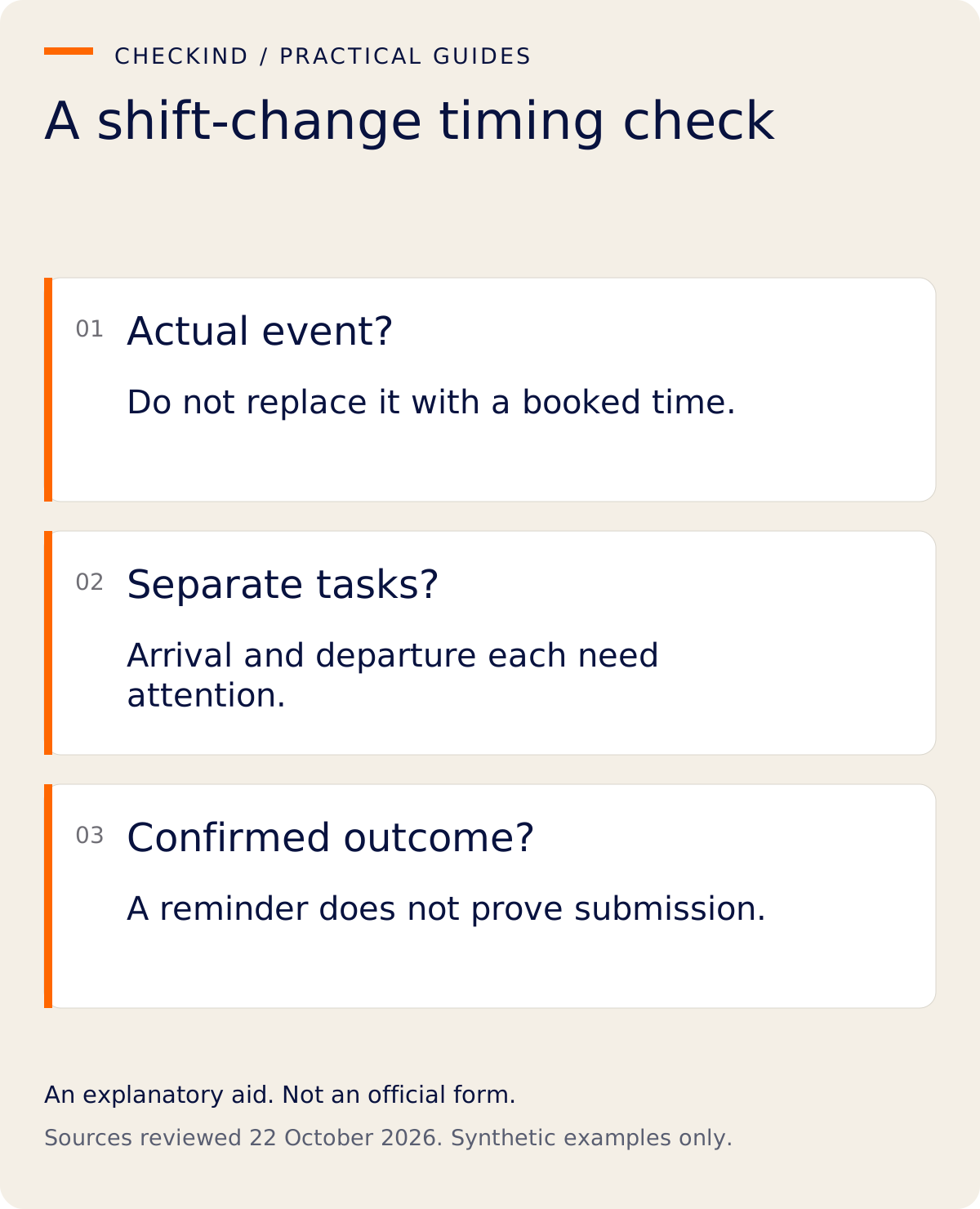
Distinguish an uncertain event time from a technical filing problem. Ask who observed the arrival or departure and what evidence the property's process retains. Do not silently replace a confirmed event with a reservation estimate to make the worksheet appear complete.
If a deadline has been missed, a report is rejected or the portal is unavailable, preserve an accurate record of the facts and promptly seek instructions from the relevant FRRO/FRO or reporting authority. This article does not establish a grace period, an approved offline fallback or an automatic waiver.
What software can and cannot prove
A reminder can help a person remember a task only if that feature exists and works for the relevant event. A calculated due time does not prove filing. A saved reference does not independently prove government acceptance.
CheckInd's expanded actual-event and Form III preparation workflow remains in development, and V2 automatic reporting reminders are not an available production promise. Check the current scope rather than assuming a timeline illustration represents a working feature.
Questions owners ask
Is the deadline the same as the hotel's standard checkout time?
No. The examples concern actual arrival and departure, not a property's advertised room policy.
Does a pre-arrival form complete arrival reporting?
No. Collecting details and transmitting an official report are separate actions.
Can the same operator handle both reports?
A small property may assign both tasks to one authorized person. It should still identify and check each task separately.
Before the next shift change, test your handover with a fictional stay crossing midnight. If the next operator cannot identify both open tasks, simplify the worksheet.
General information for covered Indian accommodation. Not a complete property-specific compliance checklist; confirm uncertain procedures with the relevant authority.
- Immigration and Foreigners Rules, 2025; G.S.R. 596(E), 1 September 2025 — Rule 17(1), (5), (6), Form III schedule
- Immigration and Foreigners (Amendment) Rules, 2026; G.S.R. 424(E), 1 June 2026 — Amendments to Rules 12, 18 and 21; no amendment to Rule 17 in this instrument
- Official Form III public portal — Public notice includes OCI; no authenticated procedure tested
- CheckInd current Form III product boundary — Digital registration is available; expanded Form III preparation remains in development.